
Fence Cleaning & Staining
in Denver, Colorado.
Refresh your fence with cleaning, preparation and staining suited to its condition and existing finish. We discuss color, product choice and maintenance needs before work begins. Serving the Denver metro with our own crew and no subcontractors.
Stain isn't vanity. It's insurance.
Sun, moisture and changing weather affect outdoor wood and its finish. We inspect the surface and existing coating, then recommend preparation and staining steps suited to your fence.
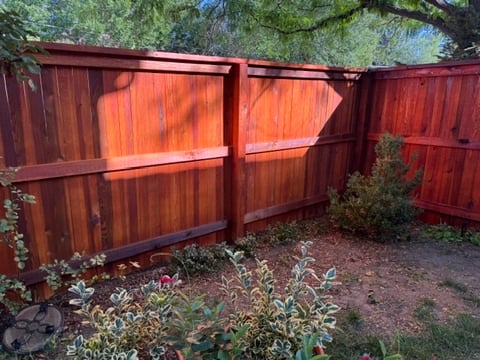
A proper oil stain fixes all of that. It blocks UV before it can damage the wood, seals moisture out during wet months, and replenishes the oils the climate leeches away. Done right, staining every 3-5 years doubles or triples your fence's useful life — which means the $1,500-3,000 you spend on staining saves you a $10,000-20,000 fence replacement.
The problem is most homeowners either (A) don't stain at all, (B) stain too early, before new cedar has released its mill oils, or (C) use cheap big-box stain that fails within 18 months. We do it properly.
Longer Fence Life
Properly stained cedar lasts double to triple the life of untreated wood.
Between Recoats
Quality oil stain in Denver's climate needs refreshing every 3-5 years.
UV Blocking
Premium semi-transparent stains block up to 90% of UV damage.
Replacement Avoided
Regular staining routinely saves homeowners a full fence replacement.
When to stain — and when not to.
Get the timing wrong and the stain fails within a year. Here's how to know your fence is ready.
Wait 2-8 Weeks
Brand new cedar is saturated with mill oils and moisture. Stain applied too early can't penetrate and peels within months. New cedar needs 2-12 Weeks of weathering (depending on sun exposure) before it's ready to accept a proper oil stain.
A quick water-drop test: sprinkle water on the wood. If it beads up, the fence is still releasing oils — wait longer. If it absorbs quickly, it's ready to stain.
Every 2-4 Years
Once your fence has been stained, maintenance recoats every 3-5 years keep the protection intact. The tell is the water bead test again — if water no longer beads on the surface, your stain has worn through and the wood is exposed.
South-facing fences in direct sun need more frequent attention than north-facing or shaded fences. We can walk your property and tell you exactly where the sun damage is concentrating.
We make it ideal for the homeowner to re-apply and maintain their own oil stain fence once installed or initially restored with us.
Full Restoration Needed
If your fence is already grey, faded, and showing splits or checks — the stain has failed and the wood has been taking direct UV damage. At this point, a simple recoat won't do it. The fence needs a full restoration: power wash, brighten, possibly sand, then two coats of premium stain.
Good news: even badly weathered cedar usually restores beautifully once we get back to clean wood.
Spring & Fall Best
Ideal Colorado staining conditions: dry wood, air temperature 50-85°F, low humidity, no rain in forecast for 24 hours, indirect sunlight during application. That narrows the good window to mid-April through early October, with the sweet spots being May and September.
We avoid summer afternoons (too hot — stain dries before it penetrates) and we never stain when rain is forecast within 24 hours.
Oil stain vs. solid stain — which is right?
Two fundamentally different products that do different things. We use both, depending on your fence's condition and what you want.
Oil-Based Penetrating Stain
What we recommend for most Denver cedar fences. Oil stain soaks into the wood rather than sitting on top, which means it protects from within rather than forming a surface film. It enhances the natural grain instead of hiding it.
Our preferred brands: Messmer's UV Plus, Penofin Red Label Oil, Sikkens semi-solid or solid stain for older fences in need of extended protection.
- Shows off cedar's natural grain and character
- Never peels or flakes — wears gracefully
- Easy maintenance recoats (no stripping needed)
- Best for cedar, redwood, and quality wood
- Semi-transparent or semi-solid options (ideal only for 4+yr old fences.)
- 3-5 year lifespan between coats (5-8 year lifespan on semisolid and solid oil stain options)
Solid Body Stain
More like thin paint than traditional stain. Solid stain has pigments that fully cover the wood, hiding grain and creating a uniform color. Best for older fences with inconsistent wood color, or pressure-treated wood that doesn't take oil stain as beautifully.
Solid stain lasts longer between coats but eventually peels and requires stripping before recoating.
- Covers wood inconsistencies and previous stain
- Uniform color, like paint
- Longer interval between coats (5-8 years)
- Best for older or weathered wood
- Many color options available
How we stain a fence properly.
Walk-Through
Inspect condition, identify repair needs, choose stain brand & color.
Power Wash
Wood-safe pressure washing with brightener to strip dirt and old finish.
Dry Time
Wood needs 24-48 hours to fully dry before stain can absorb properly.
Stain Application
Sprayed application is standard and on special situations or deck floor's Hand-applied oil stain with brush and pad, back-brushed into the grain.
Cure & Walk-Through
Additional coating where appropriate, final review and finish-care instructions. The 4-year workmanship warranty applies to installations.
What fence staining actually costs.
Pricing is typically by linear foot, with square-footage pricing available for large projects.
Recoat Existing Stain
- Light power wash
- One coat Messmer's oil stain
- Minor repairs included
- Fast turnaround (1-2 days)
- Best every 2-4 years
Full Stain & Power Wash
- Full power wash & brighten
- Two coats premium oil stain
- Choice of Messmer's, Penofin, Sikkens
- Minor repairs & nail pops fixed
- Both sides of fence (where accessible)
- Project terms in your written quote
Restoration & Stain
- Full power wash & brighten
- Sanding where needed
- Replace damaged pickets
- Two coats premium stain
- Premium Penofin, messmers or Sikkens
- Project terms in your written quote
Pricing depends on fence height, total area, access, preparation, existing coating and finish choice. The figures above are a guide; your written quote confirms the project scope, price and validity period.
Fence staining FAQs.
Protect your fence properly.
Free on-site quote. We'll test your fence's readiness, show you stain samples, and give you written pricing within 24-48 hours.